How to Move a Piano: What You Can Do Yourself and When to Stop
- How to Move a Piano Yourself: What's Realistic
- How Heavy Pianos Really Are
- Equipment and Crew for Moving a Piano
- Measure the Route Before Anyone Lifts
- How to Move an Upright Piano
- How to Move a Grand Piano
- How to Transport a Piano in a Truck
- Piano Moves in Los Angeles and Orange County
- Old and Antique Pianos: Check Before You Move
- After the Move: Placement and Tuning
- When to Call Professional Movers
- Frequently Asked Questions
Figuring out how to move a piano starts with a question that's easy to skip: should you be the one moving it? An acoustic piano is hundreds of pounds of wood, felt, and cast iron, and an upright carries that weight high enough to tip. Whether the day goes fine or ends with a gouged cabinet and a wrecked back comes down to three things. What kind of piano it is. What stands between it and the truck. And who is doing the lifting.
Below: what's realistic to do yourself, the gear and crew it takes, steps for uprights and grands, the parking and building rules around Los Angeles and Orange County, and the point where I'd call a crew.
How to Move a Piano Yourself: What's Realistic
The Piano Technicians Guild's care rules are blunt: use only a professional piano mover, and you'll avoid injury to yourself, the instrument, and your home (PTG, Basic Rules of Piano Care). As a default, I agree. Still, people look up how to move a piano yourself for ordinary reasons, like new flooring or a piano that's only going to the next room, and some of those jobs are manageable.
A do-it-yourself move makes sense only when all of these are true:
- It's an upright, not a grand or baby grand.
- The route is level, with no stairs and nothing worse than a threshold you can bridge with a ramp.
- Every doorway and turn clears with room to spare.
- You have a piano dolly, plenty of moving blankets, and at least three strong adults plus a spotter.
- The piano isn't valuable, antique, or irreplaceable to you.
Miss one, and the risk climbs fast. A grand has to come off its legs. A staircase puts hundreds of pounds directly above or below a person. And an old instrument can be damaged in ways nobody notices until a technician opens it up.
How Heavy Pianos Really Are
Weight is the first reality check, and it varies more by model than most people expect. These are the manufacturers' published weights:
| Piano | Type | Size | Listed weight |
|---|---|---|---|
| Yamaha b1 | Compact upright | 43 in. tall | 384 lb |
| Yamaha U1 | Full-size upright | 48 in. tall | 502 lb |
| Steinway K-52 | Professional upright | 52 in. tall | 650 lb |
| Steinway Model S | Baby grand | 5 ft 1 in. long | 579 lb |
| Steinway Model M | Medium grand | 5 ft 7 in. long | 603 lb |
| Steinway Model D | Concert grand | 8 ft 11¾ in. long | 1,064 lb |
Note the middle rows: a tall professional upright outweighs Steinway's smallest grand, so "it's only an upright" is not a safety plan. Uprights also pack that weight into a tall, shallow cabinet. The Yamaha U1 stands 48 inches tall but only 24 inches deep, so one wheel catching a rug edge can start a tip. Older full-height uprights deserve the same respect: Piano Buyer notes that the console was developed as a smaller, easier-to-transport alternative to the large uprights of earlier decades.
Equipment and Crew for Moving a Piano
A hand truck and a few friends is not the kit. A safe move uses:
- A four-wheel piano dolly. A low, heavy-duty platform on rubber wheels that an upright rides on the whole way. The piano's own casters are for small adjustments, and some models, like the Yamaha b1, are listed with no casters at all.
- A piano board, or skid board. The padded board a grand is strapped to once its legs come off.
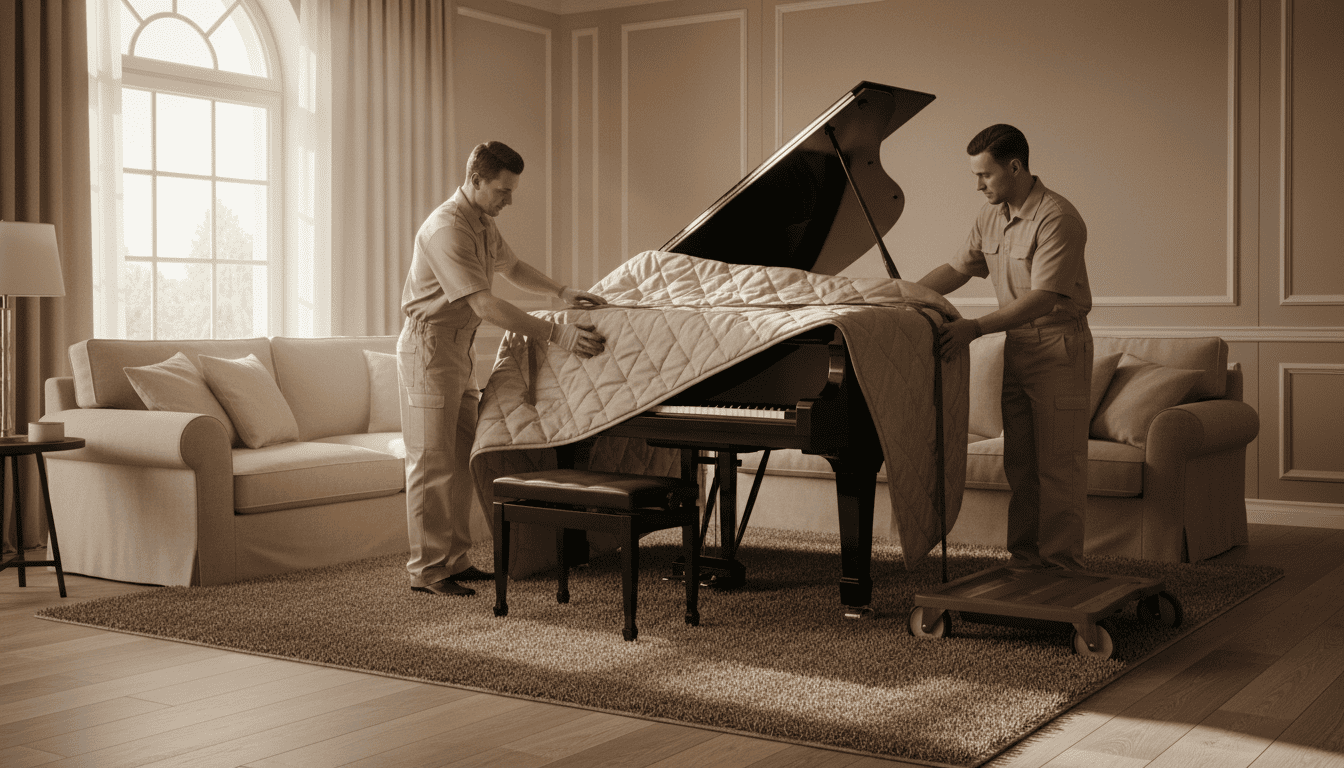
- Moving blankets and stretch wrap. Enough to cover the whole case. Tape goes on the blankets, never on the finish.
- Straps, a ramp, and floor runners. Straps hold the piano to its board and the truck wall; hardboard or plywood protects floors and bridges thresholds.
- Tools and gloves. A socket set or screwdrivers for a grand's legs, lid, and pedal lyre, grippy work gloves, and a tape measure.
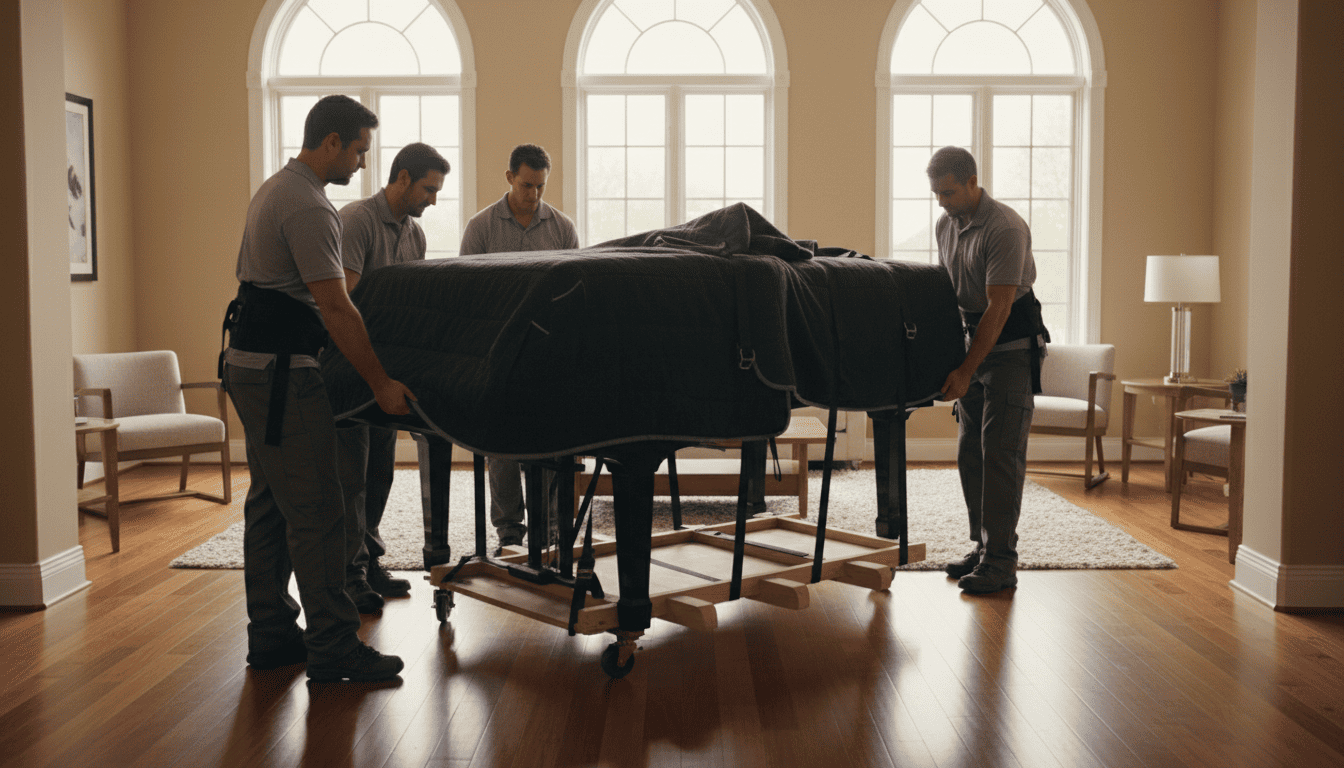
Crew size is where most DIY plans fall apart. For an upright on one level, I wouldn't go with fewer than three people plus a spotter whose only job is watching the path. A grand takes at least four, and one of them should have done it before. Why the extra person? When a piano starts to go, nobody holding it has a free hand or a clear view.
Measure the Route Before Anyone Lifts
Twenty minutes with a tape measure beats finding out in a doorway that the piano doesn't fit.
- Measure the piano. Height, width, and depth for an upright. For a grand, length and width: once it's on its side, the width becomes the height you have to clear.
- Measure every opening at its narrowest point. The hinge side and stop molding eat into a doorway's clear width; taking the door off its hinges buys back a little.
- Check turns, not just doors. A 60-inch-wide upright has to swing around hallway corners, and a tight corner can stop it even when every door is wide enough.
- Count every step, including porch steps, the drop into a garage, and sunken rooms.
- Prep both ends. Pull up rugs, lay runners, and clear the spot where the piano will live.
Stairs are where I'd draw the line on a DIY job. Our guide to moving furniture up stairs covers other heavy pieces; a piano on a staircase is work for a trained crew with proper straps.
How to Move an Upright Piano
On a level route, the sequence looks like this:
- Close it up. Lock the keyboard lid and top lid if they lock, or hold them shut under the blankets. Clear the top.
- Wrap it. Blankets over the whole cabinet, pedals and back included, held in place with stretch wrap.
- Get it onto the dolly. Two people lift one end an inch or two by the bottom of the cabinet while a third slides the dolly under; repeat at the other end so the piano sits centered. Never lift by the legs, pedals, keyboard shelf, or trim.
- Roll slowly. One person pulls and steers, one pushes, the spotter calls out obstacles, and nobody stands where the piano would land if it tipped.
- Cross thresholds on a ramp, keeping the piano square so it doesn't lean sideways.
- Park it where it will live, then lift one end at a time to remove the dolly.
A staircase, even a short one, means stop and call in help. So does a long push over a sloped driveway or broken pavement, where one stuck wheel can swing a top-heavy upright sideways.
How to Move a Grand Piano
Every grand, baby grands included, has to come off its legs, and that's the main reason I don't suggest it as a DIY project. Here's the standard sequence, so you know what a competent crew should be doing:
- Remove the music desk, lid, and pedal lyre. Wrap them, and bag the screws and pedal rods together.
- Wrap the case, leaving the legs accessible.
- Remove the first leg. The crew lifts one corner while someone takes that leg off, then lowers the case onto a padded piano board so it rests on its straight side.
- Remove the other legs, strap the piano to the board, and set the board on a dolly.
- Reverse it at the destination. The legs go on while the case is supported, the piano is lowered onto them, and the lyre goes on last.
Each step has hundreds of pounds balanced on a corner or an edge. If a leg or its hardware won't release with normal effort, stop rather than force it. And a baby grand isn't the easy version: Steinway's smallest grand, the Model S, is listed at 579 pounds.
How to Transport a Piano in a Truck
Loading is a move of its own.
- Use a ramp or a liftgate. Nobody should deadlift a piano from the street into a cargo box.
- Load it against the front wall. An upright stands with its back to the wall; a grand stays on its side, strapped to its board.
- Strap it at two heights to the tie-down points, and keep other cargo from leaning on it.
- Drive gently through turns, stops, and speed bumps.
- Unload promptly. The Piano Technicians Guild tells owners to keep pianos away from extremes of temperature and humidity (PTG care FAQs), and a closed truck in the sun is exactly that.
I'd skip open pickup beds and trailers: nothing to strap against and no cover from weather. And if the piano is leaving California, the interstate paperwork includes a coverage choice that matters for an item this heavy (more on that below).
Piano Moves in Los Angeles and Orange County
Around here, the piano is half the job. The other half is getting a truck close to the door.
Street parking. Every extra stretch of sidewalk means more time on a dolly, where a heavy upright is hardest to control. In the City of Los Angeles, LADOT's FAQ points questions about requesting temporary no-parking signs to its Special Traffic Control Division. Other cities in LA and Orange County handle street use their own way, so call the city well before moving day.
Hillside streets and Red Flag Days. When the Los Angeles Fire Department declares a Red Flag Day, parking is prohibited in posted areas of the city's Very High Fire Hazard Severity Zones, which include narrow roads, sharp curves, and hairpin turns, and illegally parked vehicles are towed (LAFD). The trigger is wind of 25 mph or more with humidity of 15% or less. If you're moving a piano out of a hillside home, check the LAFD site the day before. A declaration is a good reason to reschedule anyway: the Piano Technicians Guild puts a piano's ideal conditions at 68°F and 42% relative humidity.
Condos, towers, and HOAs. Get the move rules in writing: allowed hours, elevator reservations, floor protection, and whether the mover must provide a certificate of insurance. Measure the elevator car and its door like any other opening. Our apartment moving checklist covers the rest of the building-side prep.
Heat and traffic. In summer, start early so the piano isn't riding in a hot truck all afternoon, and plan the drive around rush hour.
Old and Antique Pianos: Check Before You Move
An heirloom upright raises a question that has nothing to do with lifting: is it worth moving? Hannah Beckett, publisher and editor of Piano Buyer and a piano technician, points out that pianos have limited lifespans, that one which can't be tuned or maintained has reached the end of its life, and that a family planning to play an old piano should have a technician evaluate it before the move. Donating isn't an easy exit either: Beckett notes that many institutions have been burdened with donated pianos they couldn't use and no longer accept them.
If the piano is worth keeping, give it extra care:
- Document it first. Photograph the case, keys, legs, and any lifting veneer or cracks. Those photos are your baseline if something goes wrong.
- Avoid climate swings. PTG warns that extreme humidity swings can eventually crack wood and make glue joints fail (PTG care FAQs), so an old case shouldn't wait in a hot truck.
- Guard against drops. In a Piano Technicians Journal case study, a Baldwin piano service manager explains that a broken plate usually comes from major trauma, such as a drop, or from a defect in the plate, and that the crack may not show up for quite some time.
- Don't force old hardware. If decades-old leg bolts or lyre screws won't give with normal effort, stop.
- Plan for more than a tuning. A piano left untuned for an extended period may need a pitch raise before it can be accurately tuned (PTG).
After the Move: Placement and Tuning
PTG's basic care rules say to keep a piano away from heating registers, air conditioning vents, fireplaces, frequently opened windows or outside doors, and direct sunlight.
Then give it time before the tuner comes. A piano stays in tune only as long as the humidity around its soundboard stays constant, according to PTG, and a new room means new conditions. Piano Buyer advises tuning a newly delivered piano again within a month or two, once it has had time to acclimate. For a piano that has just been moved, I'd book the tuner about a month out. Look for a Registered Piano Technician, a PTG credential earned by passing exams on maintenance, repair, and tuning.
When to Call Professional Movers
Call a crew if any of these apply:
- It's a grand or a baby grand.
- There are stairs anywhere on the route.
- A doorway, turn, or elevator leaves only an inch or two of clearance.
- The truck can't park close, or the carry crosses a sloped driveway.
- The piano is valuable, antique, or impossible to replace.
- The piano is going out of state.
Whoever you hire, verify them. For a move within California, the California Moving and Storage Association advises checking that the mover is licensed with the Bureau of Household Goods and Services, with its Cal-T number on documents and ads, and notes that BHGS rules require a written not-to-exceed price before the move. For an interstate move, search the registered mover database on FMCSA's Protect Your Move site.
Then check coverage. Interstate movers must offer Full Value Protection and Released Value, and Full Value applies unless you sign for Released Value, which caps the mover's responsibility at 60 cents per pound per article (FMCSA). For a 502-pound Yamaha U1, that's about $301. Read what you sign.
If your piano is in Los Angeles or Orange County, our crews move uprights, baby grands, and grands through Green Moving's white glove moving service, with a four-mover crew for pianos. Our license, CAL-T201327, is issued by BHGS, and the pricing page shows how piano handling is billed.
Frequently Asked Questions
How many people does it take to move a piano?
For an upright on a flat floor, I'd want at least three people plus a spotter. For a grand, or anything involving stairs, a trained crew of four is the minimum I'd consider. Two people can't hold a piano and react to a tip at the same time.
Can I roll a piano on its own casters?
Only for small adjustments in place. Pushing an upright across rooms, over thresholds, or down a driveway on its small casters invites a stuck wheel, and on carpet a caster can catch while the top keeps moving. For anything longer than a nudge, use a four-wheel piano dolly.
How do you move a baby grand piano?
The same way as a full grand: lid, music desk, and pedal lyre off, one leg removed while the crew supports that corner, the case lowered onto a padded piano board on its straight side, then the remaining legs off. A baby grand is shorter, not light, so treat it as a job for an experienced crew.
Do you need to tune a piano after moving it?
Plan on it. According to the Piano Technicians Guild, a piano stays in tune only while the humidity around its soundboard stays constant, and a move puts it in a new room with new conditions. Give it a few weeks to settle, then book a Registered Piano Technician.
Is an old piano worth moving?
Sometimes, and a technician is the right person to decide. As Piano Buyer explains, pianos have limited lifespans, and one that can no longer be tuned or maintained won't be rescued by a new address. Get it evaluated before you pay to move it, especially if your backup plan is donating it.