How to Move Furniture Up Stairs Without Wrecking Your Back or Walls
- Measure the Furniture, the Stairs, and Every Door
- Take Apart Everything That Comes Apart
- Protect the Stairwell (and Your Security Deposit)
- The Gear That Does the Heavy Lifting
- Who Goes on Top and Who Goes on the Bottom
- Turning at the Landing and Getting Through the Door
- Sofas, Mattresses, and Dressers
- Walk-Ups, Outdoor Stairs, and Building Rules in LA and OC
- When to Stop and Call Movers
- Frequently Asked Questions
Here's the stair carry nobody wants: the dresser comes off the truck fine, rides a hand truck to the bottom step, then jams at the first landing, pinned between the wall and the handrail while the person below holds most of the weight. If you're working out how to move furniture up stairs, plan for that landing before anyone lifts anything. The real work starts with a tape measure.
This guide is for doing it yourself with at least one helper, and it's written with Los Angeles and Orange County walk-ups in mind. Wondering how to move heavy furniture up stairs by yourself? I hope that means without movers, not alone. Either way, the order you do things in matters more than muscle.
Measure the Furniture, the Stairs, and Every Door
Moving furniture upstairs is mostly a geometry problem. Take a metal tape measure, walk the whole route from where the truck parks to the room where the piece will live, and write everything down.
| Measure | How | Why it matters |
|---|---|---|
| The piece | Height, width, and depth with cushions and legs off | Your baseline for every clearance |
| Sofa diagonal depth | On the side profile, from the top corner of the back to the opposite bottom corner | Decides whether a sofa clears a doorway |
| Stair width | At hand height, between the handrail and the wall or between two rails | The narrowest point is rarely the tread |
| Headroom | From the stair nosings up to the lowest beam, light, or ceiling | Limits how you can tilt tall pieces |
| Landings | Width, depth, and ceiling height | Tells you whether a piece can stand on end to turn |
| Doors | With the door open 90 degrees, from the face of the door to the stop, plus height | The real opening is narrower than the door itself |
Don't expect generous numbers. Under the 2025 California Building Code, a stairway serving fewer than 50 people can be 36 inches wide, and handrails may project 4½ inches into that width on each side, which leaves as little as 27 inches between two rails. Headroom only has to reach 80 inches. Your unit's entry door needs 32 inches of clear opening, and code exempts some doors inside a unit from even that minimum. Older buildings can be tighter still, so measure yours.
Then compare. CB2's delivery guide is blunt about sofas: one only fits if its diagonal depth is smaller than the doorway's width. If it isn't, no clever angle will save you. The legs come off, the door comes off, or the sofa stays downstairs.
Take Apart Everything That Comes Apart
Every pound and every inch you remove before the stairs is one you don't have to fight on them.
- Sofas and sectionals: cushions off, legs unscrewed, sections unhooked.
- Dressers and chests: drawers out, mirror or hutch unbolted.
- Beds: headboard, footboard, rails, and slats separated.
- Tables and desks: legs, leaves, and glass tops removed.
- Bookcases and wardrobes: shelves and doors out.
Take a photo of each piece before you start. Bag the screws and bolts, label the bag, and tape it to an unfinished surface of the same piece with painter's tape. Go easy on flat-pack furniture, though: particleboard can lose its grip on screws each time they go back in, so take it apart only as far as the stairs require.
The door counts, too. Most interior doors lift off once you tap the hinge pins up and out, and that wins back the width the open door was taking from the opening.
Protect the Stairwell (and Your Security Deposit)
Furniture mostly hits walls on the turns, not on the straight runs. So put your padding where you'll pivot: the corners at the top and bottom of each flight, the landing walls, the railing posts, and the door frames.
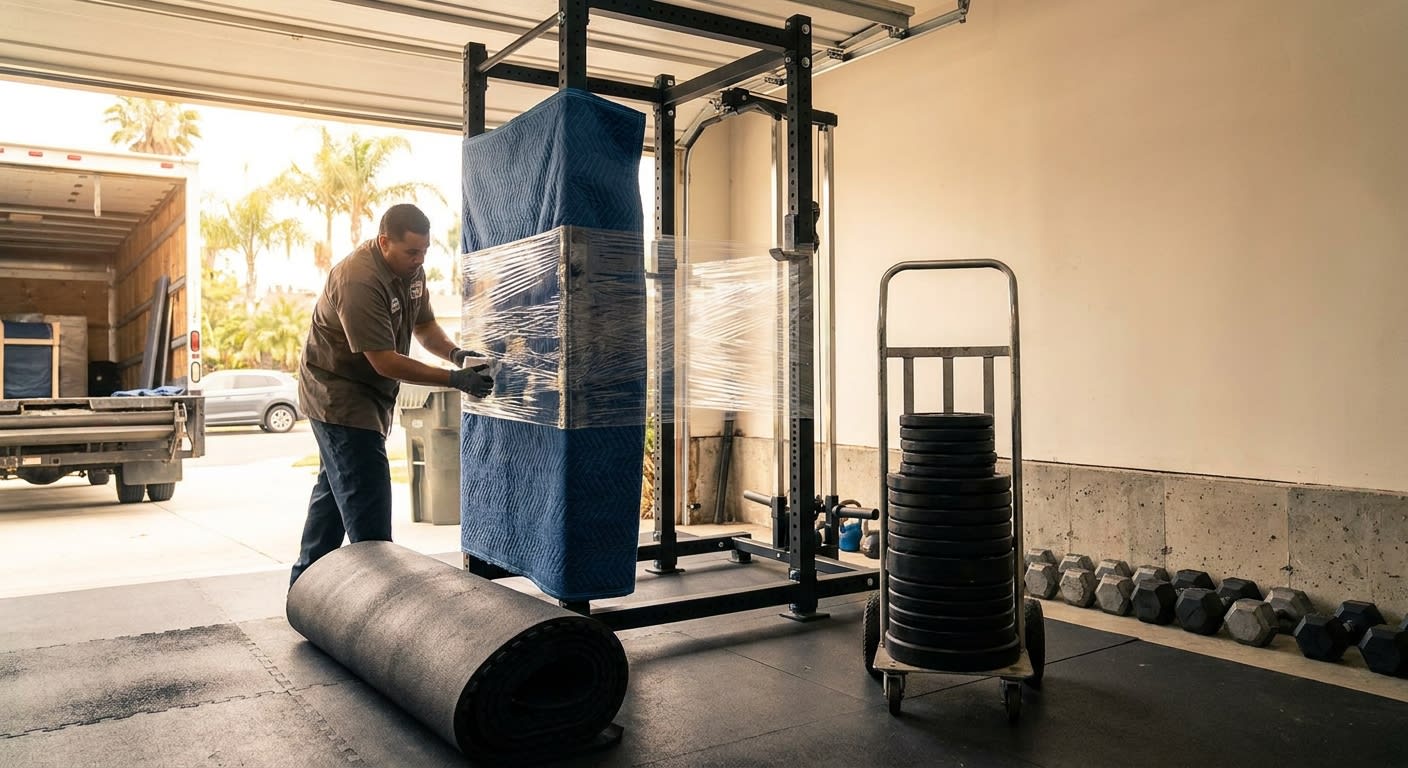
- Wrap each piece in moving blankets and hold them on with stretch wrap rather than tape on the finish.
- Cover wall corners and railing posts with corner guards or folded blankets. Use painter's tape on walls; duct tape can pull paint.
- Take down anything hanging on the walls along the route.
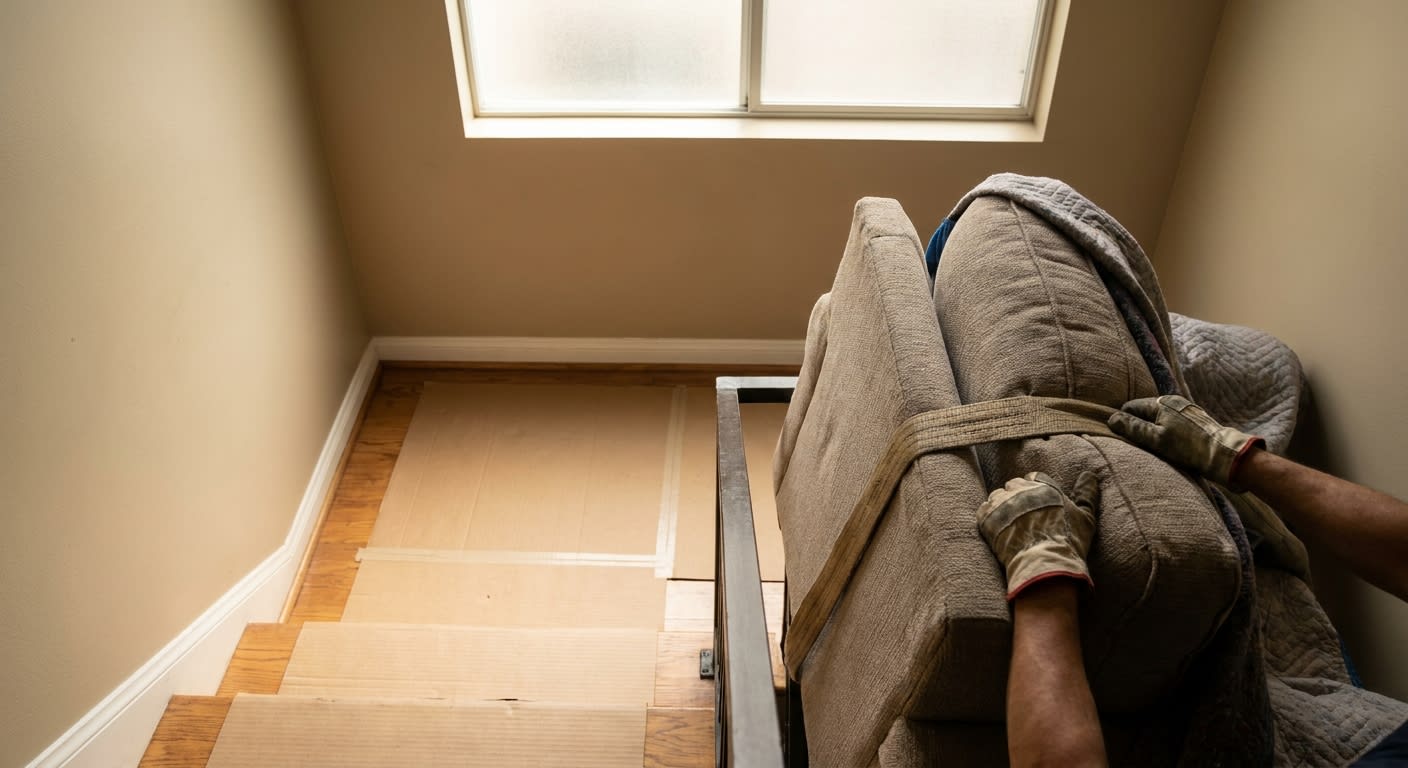
- Never lay loose blankets or cardboard on the treads, because they slide underfoot. If you protect hardwood steps with cardboard runners, tape every edge down; on carpeted stairs, adhesive protection film stays put.
There's a money reason to be fussy. California's security deposit law, Civil Code §1950.5, lets a landlord use your deposit to repair damage beyond ordinary wear and tear caused by the tenant or by the tenant's guest. A doorframe your friend gouges is still your doorframe. For tenancies starting on or after July 1, 2025, the same section also requires the landlord to photograph the unit at move-in. Take your own date-stamped photos of the carry route anyway.
The Gear That Does the Heavy Lifting
Three tools cover most stair carries. Hand trucks and furniture pads are standard add-ons at truck-rental counters; straps you'll probably have to buy.
Lifting straps
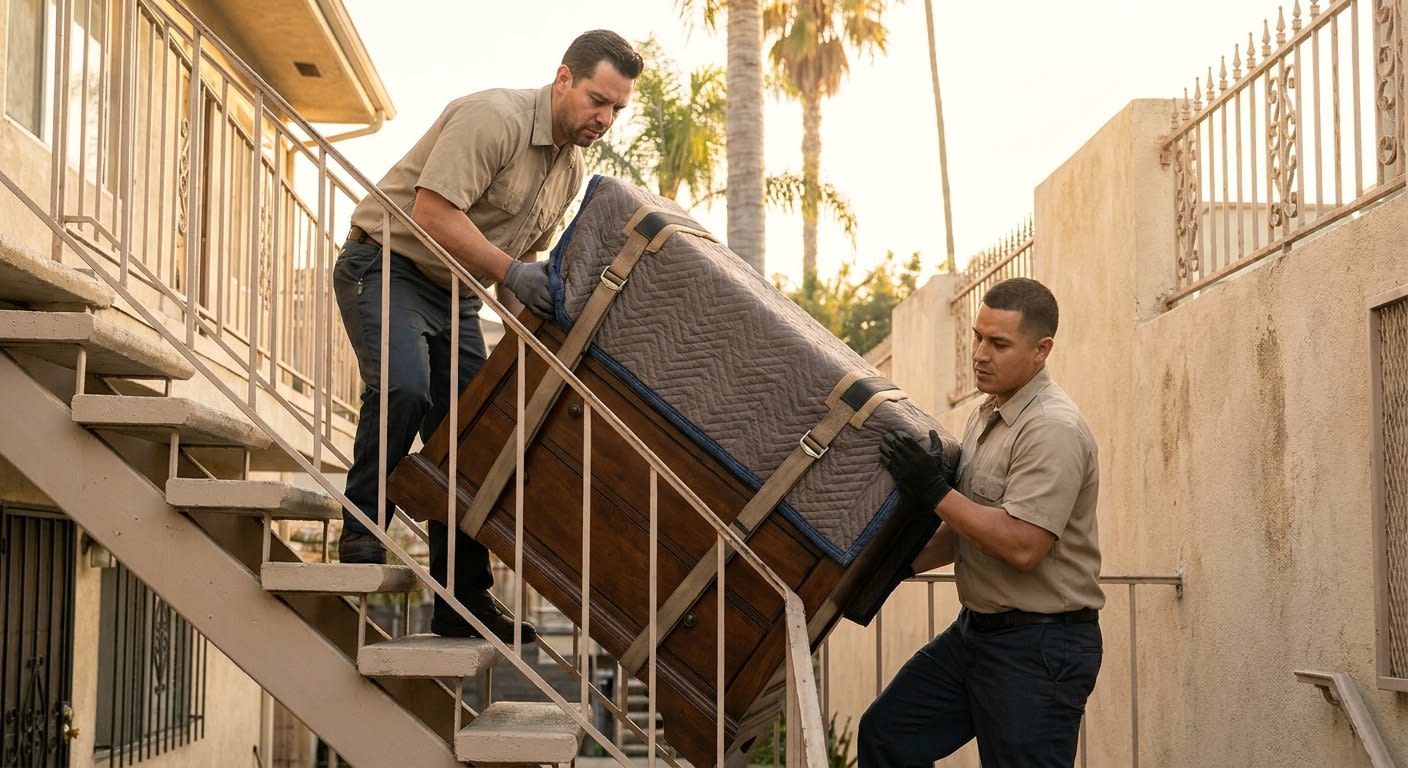
Straps run under the piece and attach to both carriers, so the weight hangs from your shoulders or forearms and your legs do the work instead of your fingers and lower back. For stairs, I'd pick the shoulder-harness style over forearm straps: your hands stay free to steady and steer, and neither of you has to grip a bottom edge. Whatever you use, keep the straps snug. As the piece tilts on the stairs, its weight shifts toward the person below.
A hand truck
For rigid, boxy pieces that sit flat on the plate, like dressers, chests, file cabinets, and appliances, a hand truck beats carrying. Get an appliance hand truck with a built-in ratchet strap. It's the wrong tool for anything that won't sit steady on the plate or stands taller than the person handling it. To take it up a flight:
- Slide the plate under the piece, strap it tight, and tip it back until the weight balances over the wheels.
- The handler stands above it, facing down the stairs, and pulls it up one step at a time while stepping backward.
- A helper below keeps both hands on the frame to push and steady it.
- Stop on the landing and reset before the next flight.
Stair-climbing models with three-wheel clusters roll over step edges instead of bumping into them.
Sliders, gloves, and shoes
Sliders do nothing on the steps themselves, but they save your back everywhere else: across the unit, down the hall, across a landing while you line up the next flight. Hard plastic sliders glide on carpet; felt-bottom ones are for wood and tile. Add grippy work gloves and closed-toe shoes with real tread. Stairs in flip-flops are a bad bet.
Who Goes on Top and Who Goes on the Bottom
Start with a reality check on weight. NIOSH's Revised Lifting Equation, a workplace tool for two-handed lifting, begins with a load constant of 51 pounds, the weight considered safe for an ideal lift. Then it lowers that number as conditions get worse: the load held far from the body or low to the floor, twisting, a poor grip, frequent lifts. A dresser on a staircase breaks most of those conditions at once. Two people, straps, and a hand truck aren't overkill. They're how each person's share stays reasonable.
On stairs, a tilted load's weight shifts downhill, so the person below carries more of it. That settles the lineup:
- Bottom carrier: the stronger lifter. Keeps the load close, lifts with the legs, and sets the pace.
- Top carrier: walks backward up the stairs holding the high end, steers, and feels for each step with a heel before shifting weight.
- Spotter, if you have a third person: stays above the top carrier, calls out steps and the landing, opens doors, and clears the path. Never below the load.
Tip tall pieces back so they run roughly parallel to the stairs, with the top carrier on the upper end and the bottom carrier on the lower end. That keeps the load stable between you and low enough to clear the stairwell ceiling. Both of you: back straight, knees and hips bent, piece close to the body, and turn with your feet instead of twisting at the waist.
Agree on the words before the first lift ("lift," "step," "stop," "set it down") and let one person call them. Carry the heaviest pieces first, while everyone is fresh, and rest on landings, never with a piece balanced on a step. If something starts to slide, nobody tries to catch it. The person below gets out of the way. A dented dresser is cheaper than a broken wrist.
Turning at the Landing and Getting Through the Door
Landings are where stair carries stall, and code doesn't promise much room. The California Building Code requires a landing only as wide as the stairway it serves and as deep as that stairway is wide, up to 48 inches. A door opening onto the landing can take up to half of that width while it swings. On a 36-inch stair, a 3-by-3-foot landing is perfectly legal.
- Set the piece down on the landing and reset your grips before you try to turn.
- Stand it on end if it's longer than the landing is deep. That borrows the height of the stairwell, which only works if the piece is shorter than the ceiling at the landing. You measured that, right?
- Pivot, don't drag. Rotate it on a slider or a folded blanket, then tip it back to the angle of the next flight.
- Use the air over the railing. On switchback stairs, you can swing the end of a long piece above the handrail as you turn. Never rest the weight on the rail.
Doorways work the same way. Chairs and sofas often go through best standing on end: tip the upper end through first, then curl the rest of the piece around the door frame, like threading a fishhook. Take the unit's door off its hinges, or prop it flat against the wall, so it isn't blocking the landing while you turn.
Sofas, Mattresses, and Dressers
Sofas and sectionals
With cushions, legs, and brackets off, check the diagonal depth against every door. Carry the sofa up the flight on its back or its end, and stand it upright at the turns. If it's a sleeper, tie or wrap the fold-out mechanism closed so it can't open when you tilt it. With an L-shaped section, decide before you lift which way the short leg will point at each turn. Often the answer is up and over the handrail.
Mattresses and box springs
A mattress goes up on its long edge, one person at each end, in a mattress bag to keep it clean. Don't fold it to get around a tight turn. Mattress maker Amerisleep warns against folding innerspring and hybrid mattresses at all, since a single sharp bend can permanently kink the coils, and notes that most warranties don't cover a mattress that's been bent or folded. Thin all-foam mattresses tolerate a gentle curve better. A box spring won't bend at all, so if it can't clear the landing on edge, a split box spring is the workaround.
Dressers and chests
Pull the drawers and take off any mirror, and a dresser becomes the ideal hand-truck load: rigid, flat-backed, boxy. Strap it on and take the stairs one step at a time. Carrying it by hand instead? Tip it back along the slope with the stronger person below, and never let a tall chest stand free on a step. Top-heavy pieces tip.
Walk-Ups, Outdoor Stairs, and Building Rules in LA and OC
Southern California adds its own twists. The dingbat, which the LA Conservancy calls a very common mid-century building type in Los Angeles, is usually two or three stories of stucco over ground-level parking. When the ground floor is parking, the apartments are upstairs, and so is everything you own.
- Outdoor stairs: sweep off sand, leaves, and water before the first carry, and don't carry in the rain. Wind turns a mattress into a sail.
- Heat: on summer move days, do the heavy pieces in the cool early hours and drink water between trips.
- Building rules: ask the manager or HOA about move hours and whether a service elevator can be reserved. If there's an elevator, use it; the stairs are the fallback. Our LA apartment moving checklist covers the rest of the building-side prep.
- The truck: the carry from the curb to the first step counts. Park as close as you legally can, and check street-sweeping signs and whether your city requires a permit for the truck.
- Kids and pets: keep them off the stairs and out of the route, in a closed room or with another adult, until the heavy pieces are inside.
When to Stop and Call Movers
Stairs hurt people even when their hands are empty. A study of U.S. emergency department data in the American Journal of Emergency Medicine estimated an average of 1,076,558 stair-related injuries treated each year from 1990 through 2012, with sprains and strains the most common type. Put a dresser in those hands, and the margin for error shrinks.
Knowing how to move furniture up stairs includes knowing when to set a piece back down. Stop and rethink if:
- the measurements say it won't fit, because no angle fixes bad math;
- it needs more than two people and the stairs only fit two;
- anyone's grip, back, or knees are giving out, since tired feet miss steps;
- the stairs are spiral or wet, or the railing wobbles;
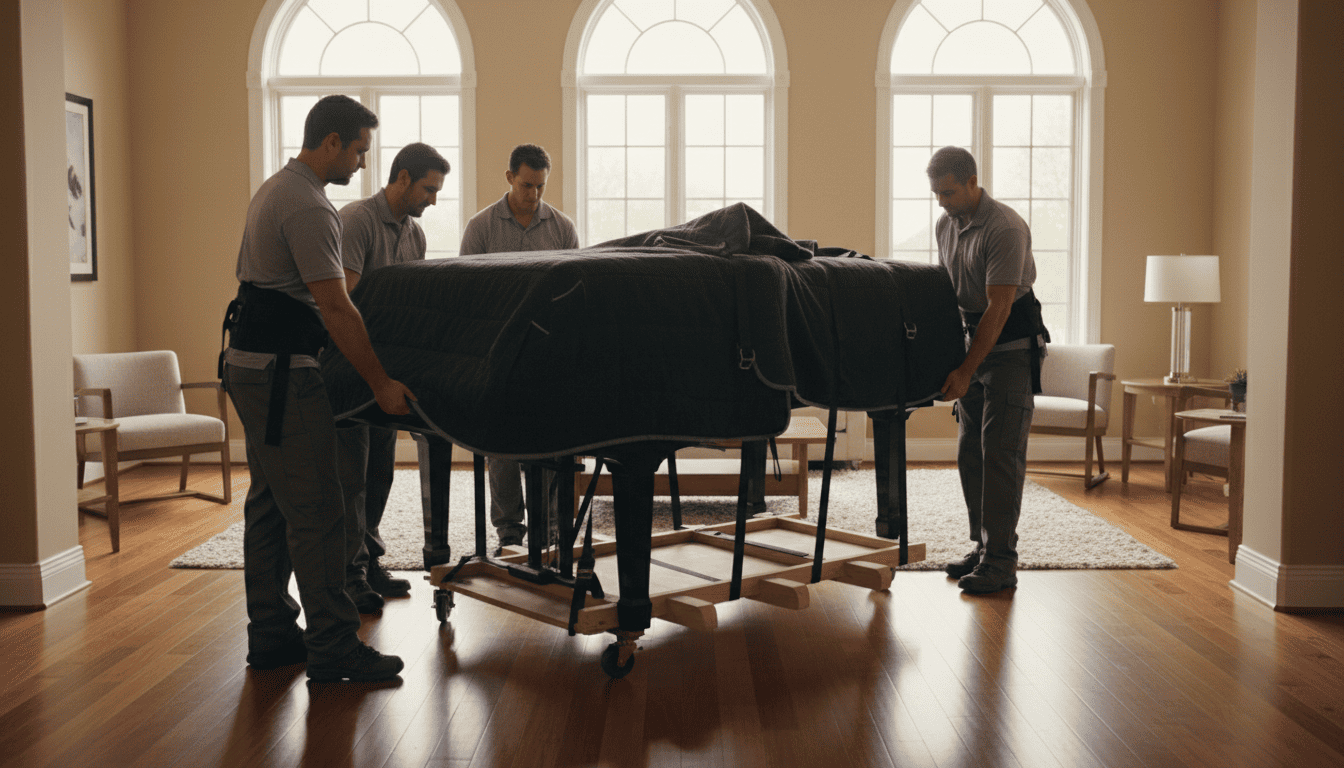
- it's a piano, a gun safe, a stone-top table, or anything the two of you can't lift an inch off the floor.
Pianos in particular are their own discipline, and our Los Angeles piano moving guide explains why. If you hit any of the other stop signs, Green Moving's residential moving crews handle apartments and multi-story homes with floor runners, wall padding, and doorway protection. Whether you need a local move within LA and Orange County or a long-distance one, current rates are on our pricing page.
Frequently Asked Questions
What's the best way to move furniture up stairs?
Measure the piece and every clearance first, then strip it down and pad the corners where you'll turn. Carry long pieces with two people and lifting straps, and strap boxy ones like dressers to a hand truck. Either way, the stronger person takes the bottom.
Who should be on the bottom when carrying furniture up stairs?
The stronger person. As a piece tilts on the stairs, its weight shifts downhill, so the bottom carrier holds more of it. The top carrier walks backward, holds the high end, and steers.
Can one person move heavy furniture up stairs alone?
Not safely. NIOSH's recommended limit shrinks fast once a lift stops being ideal, and stairs are far from ideal. Alone, carry only parts light enough to hold close to your body; the heavy frame waits for a second person.
Which is better on stairs, a dolly or moving straps?
It depends on the shape. A hand truck suits rigid, boxy pieces that sit flat on its plate, such as dressers, file cabinets, and appliances. Straps suit long or awkward pieces like sofas. On spiral stairs, neither works well.
How do you get a mattress up a narrow staircase?
Carry it on its long edge with one person at each end. Don't fold an innerspring or hybrid mattress around a turn, since that can damage the coils. If a box spring won't clear the landing, a split box spring solves it.
How many people does it take to carry a couch up stairs?
Two people can carry most sofas, and a spotter walking ahead to call out steps makes it safer. Sleeper sofas and large sectional pieces are heavier and harder to turn, so plan on more help.