How to Move a Gun Safe: Weight, Gear, Stairs, and Anchoring
- Start With the Safe's Real Weight and Size
- Empty It First, and Know California's Rules for the Guns
- Measure the Route and Prep Both Homes
- Equipment You Need, and Tricks to Skip
- How to Move a Gun Safe Step by Step
- How to Transport a Gun Safe in a Truck or Trailer
- Level It and Anchor It at the New Place
- Moving It Yourself vs. Hiring Pros
- Frequently Asked Questions
A gun safe is built so that nobody can walk out of your house with it. On moving day, that includes you. Figuring out how to move a gun safe comes down to numbers most owners never look up. What does the safe weigh? How wide is every doorway on the route? What are your dolly, stairs, and vehicle rated to carry? Get those right and it's a slow, careful job. Guess, and you're betting your back, your floors, and maybe a tailgate.
Here's the whole job in order, California's rules for the guns included, plus the point where a crew makes more sense.
Start With the Safe's Real Weight and Size
Don't eyeball it. Steel thickness and fire insulation add weight you can't see, so two safes that look alike can be hundreds of pounds apart. Find the brand and model in your paperwork or order confirmation and pull the manufacturer's spec sheet. Here's the spread within one brand, Liberty Safe:
| Model | Outside size (H × W × D) | Minimum doorway (maker's figure) | Listed weight |
|---|---|---|---|
| Centurion 12 | 59.5 × 18.25 × 16 in. | 18 in. | 245 lb |
| USA 30 | 60.5 × 30 × 22 in. | 24 in. | 565 lb |
| USA 50 | 72.5 × 42 × 27.5 in. | 29.5 in. | 930 lb |
| Lincoln 50 | 72.5 × 42 × 27.5 in. | 30 in. | 1,194 lb |
| Classic Select 60 | 72.5 × 50 × 27.75 in. | 24.75 in. | 1,516 lb |
The USA 50 and the Lincoln 50 have the same outside dimensions and sit 264 pounds apart. And the table isn't the ceiling: Liberty's tips for moving a safe on your own note that a home-size safe with composite, concrete, or poured-in insulation can weigh up to 3,100 pounds.
Measure two more things. Depth with the handle on: the same guide points out that an assembled safe can be deeper than a new one, since installers sometimes attach the handle after the safe is in place. Treat a published minimum doorway as the best case. And the diagonal, which decides whether the safe clears a tight corner or the ceiling over a staircase.
Empty It First, and Know California's Rules for the Guns
Moving a gun safe with anything still inside is a bad bet. Liberty's guide says to empty it before you shift it at all: guns and ammo are heavy, and contents that slide around can tip the balance while it's moving. Take everything out, then close and lock the door so it can't swing open on the dolly.
Before you shut it, make sure you can get back in: a fresh battery in an electronic lock, the code or combination tested. You'll need the door open at the new place: most full-size safes have pre-cut anchor holes, typically in the floor of the safe under the floor panel, per Liberty's installation guide.
Carry the guns yourself. Don't assume a moving crew will take them; ask about the company's firearm and ammunition policy when you book. And ask your insurer whether the collection is covered in your car and at the new address.
California rules for the guns themselves
- Unloaded.Penal Code 25850 makes it an offense to carry a loaded firearm in a vehicle on a public street or in a public place in an incorporated city or a prohibited unincorporated area. For that section, a gun is loaded if a live round is in it or attached to it, including in an attached magazine (Penal Code 16840).
- Handguns locked up. The transport exemption in Penal Code 25610 requires a handgun to be unloaded and locked in the trunk or in a locked container in the vehicle, or carried directly to or from the vehicle in a locked container.
- The glove box doesn't count.Penal Code 16850 defines a locked container as fully enclosed and locked by a padlock, keylock, combination lock, or similar device, and it excludes a vehicle's glove or utility compartment.
- Moving in from another state? For firearms acquired elsewhere, Penal Code 27560 gives new residents 60 days to report them to the Department of Justice or to sell or transfer them through the routes the law lists. Other California restrictions can apply, so read up before the trip.
That's the statute text in plain English, not legal advice. Several of these sections were amended recently, so check the current version or ask a firearms attorney if your situation isn't simple.
Measure the Route and Prep Both Homes
Most of the work of moving a safe happens before anyone touches it. Walk both routes with a tape measure: safe to truck, then truck to the new spot.
- Doorways. Measure the clear opening with the door fully open, not the door itself. A house door can come off its hinges if you need the room.
- Corners and stairs. Compare the safe's diagonal with turns, landings, and the ceiling over the stairs. Liberty suggests a cardboard mock-up of the safe for a dry run, and its guide to getting a safe upstairs says to confirm the stairs can hold the safe plus the people moving it.
- Floors. Lay plywood or hardboard over hardwood, tile, and thresholds. Professional safe movers typically put down blankets or plywood before bringing a safe in, per Liberty's delivery guide.
- The floor at the other end. If you're not sure it can take the weight, Liberty recommends having a building contractor evaluate it first (where to install a gun safe).
Stairs, elevators, and curbs in LA and Orange County
Condos and apartments: call building management before you book anything. Ask about a service elevator and its rated capacity, reservations, allowed move hours, and whether they need a certificate of insurance from your mover.
Houses have their own traps: hillside lots with long exterior stairs, split-level entries, steep driveways. Every extra step is more distance on the dolly, so decide where the truck will stop before moving day. There's more on stairwells in our guide to moving heavy furniture up stairs in LA apartments.
Then the curb. The City of Los Angeles restricts curb parking with temporary tow-away signs. Its MyLA311 knowledge base says requests must be made at least 10 business days in advance; the signs go up two days before. Other cities in LA and Orange County set their own rules, so check early.
Equipment You Need, and Tricks to Skip
You don't carry a safe. You tilt it, strap it, and roll it, and every piece of gear in that chain needs a rating above the safe's weight.
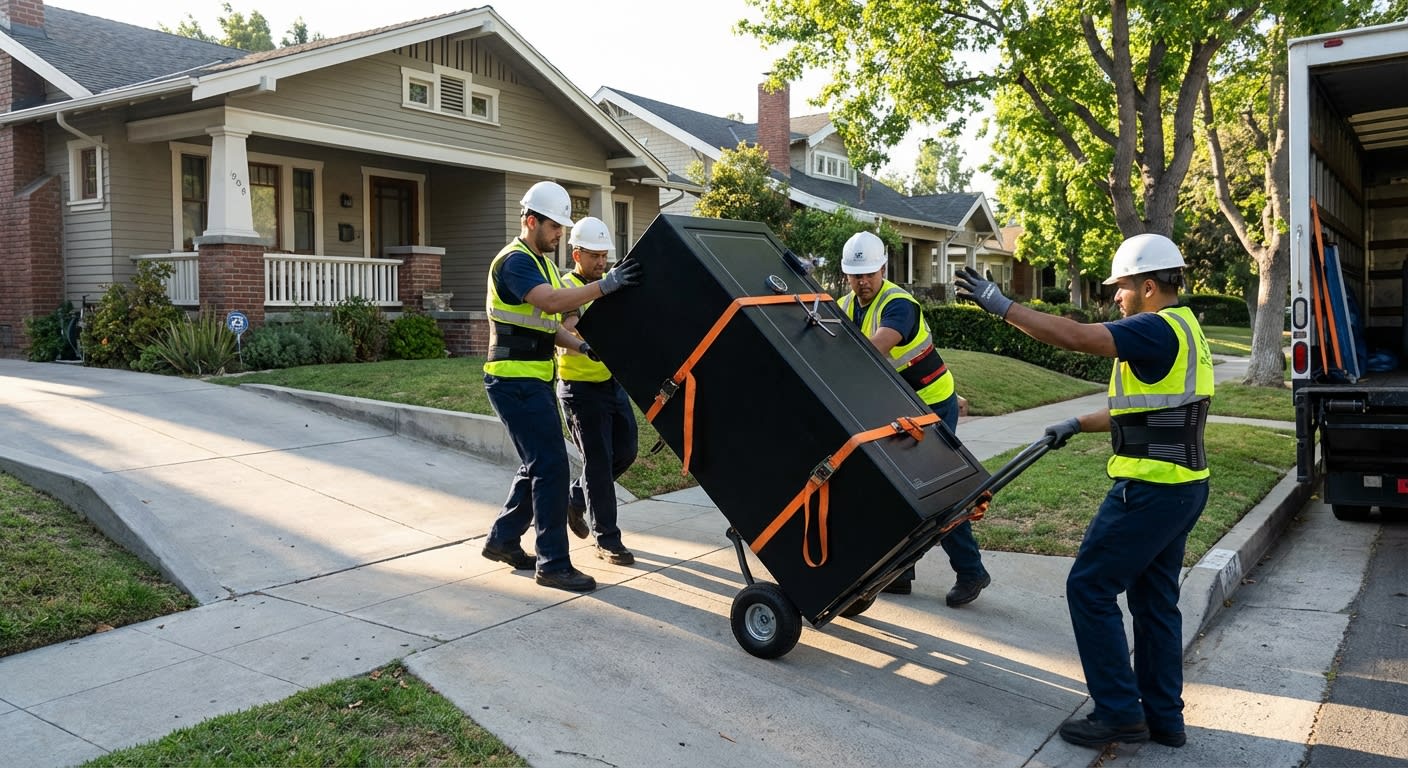
- A heavy-duty appliance dolly with straps, rated for more than the safe weighs. Liberty warns that regular dollies can bend under a big safe and that air-filled tires can pop under the load.
- A powered stair-climbing dolly if there are steps anywhere on the route; Liberty says an electric stair climber makes the job much easier. Can't rent or borrow one? That's a strong hint about who should do this.
- Ratchet straps: two or more for the dolly, more for the vehicle.
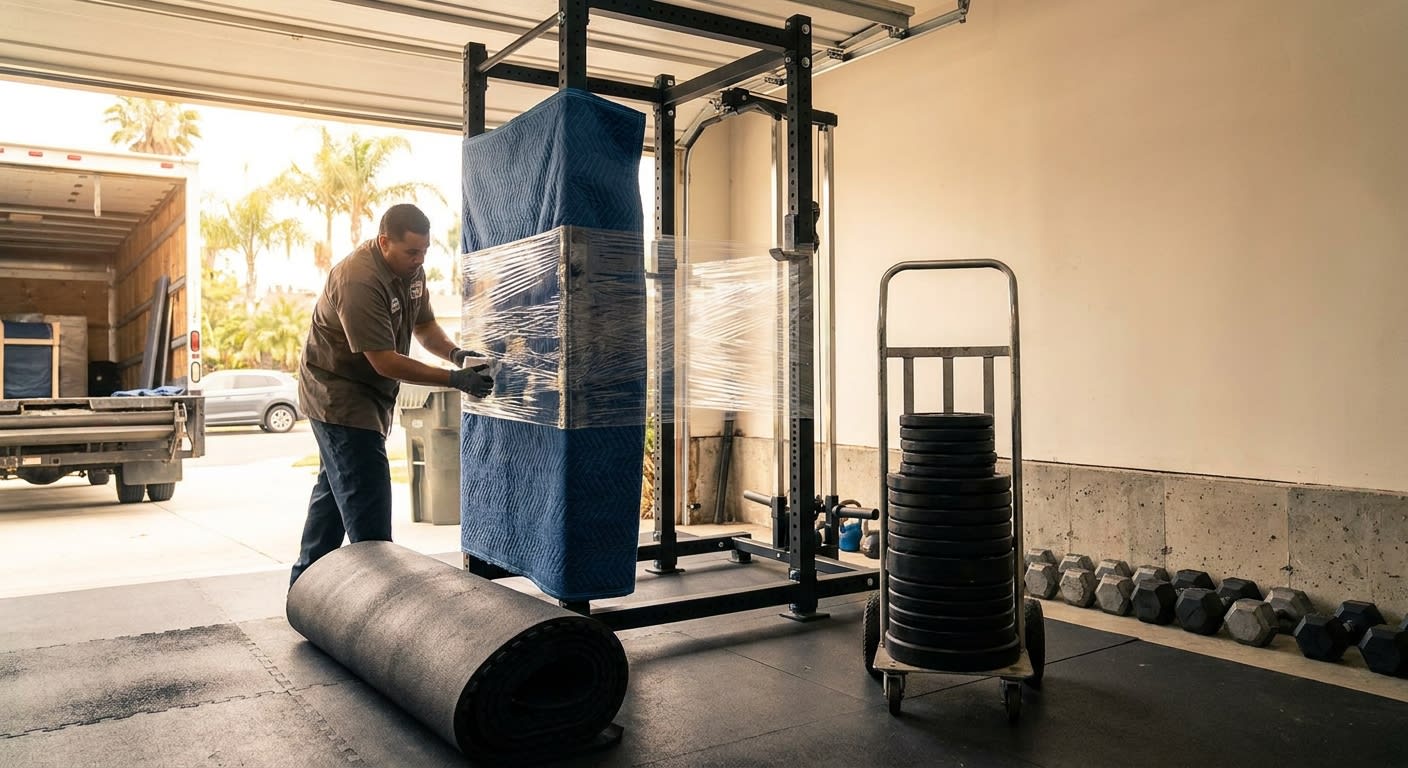
- Moving blankets and stretch wrap to protect the finish, door frames, walls, and any fingers that get pinned against a wall.
- Plywood or hardboard for floors, thresholds, and changes in floor height.
- Work gloves and closed-toe shoes with good grip; Liberty suggests steel-toed boots.
- At least three strong helpers. That's Liberty's number, and I wouldn't go below it.
What not to use
- Golf balls. Liberty's moving tips call them a terrible idea except maybe on very smooth concrete: they can leave divots in wood and linoleum, break tile, and stop rolling on carpet.
- PVC pipe rollers on anything but smooth, clean, hard floors. They hang up in grout lines and uneven spots and don't work on carpet. Pros use slick sticks instead: polymer-faced bars laid out as a track.
- The handle. Most quality safes have a clutch or break-away handle so thieves can't use it for leverage, and Liberty says not to tie straps to the dial, the handle, or any other hardware.
- Bungee cords. They stretch, which is the opposite of what you need.
How to Move a Gun Safe Step by Step
Do the safe first thing on moving day, while everyone is fresh and before boxes crowd the path.
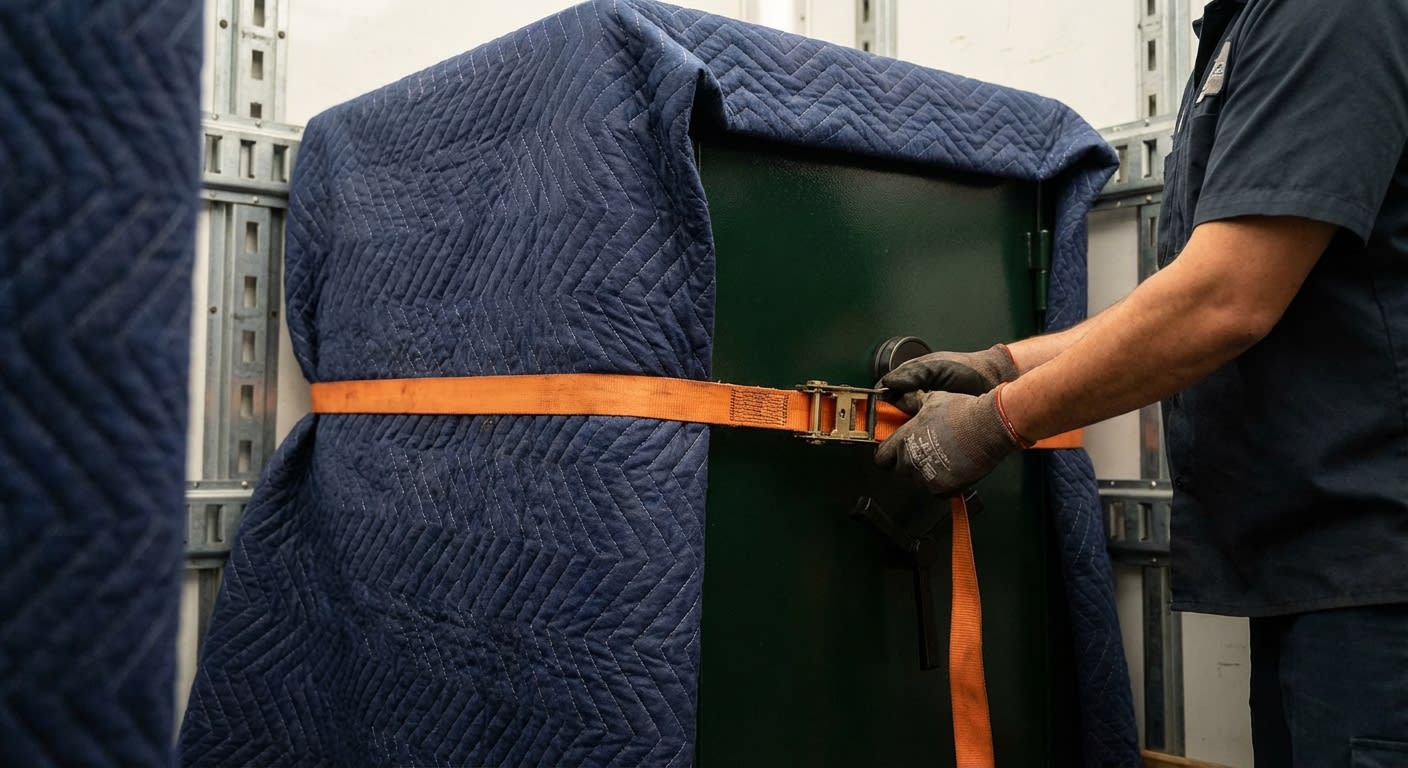
- Wrap it: blankets on every side, stretch wrap over them, door closed and locked.
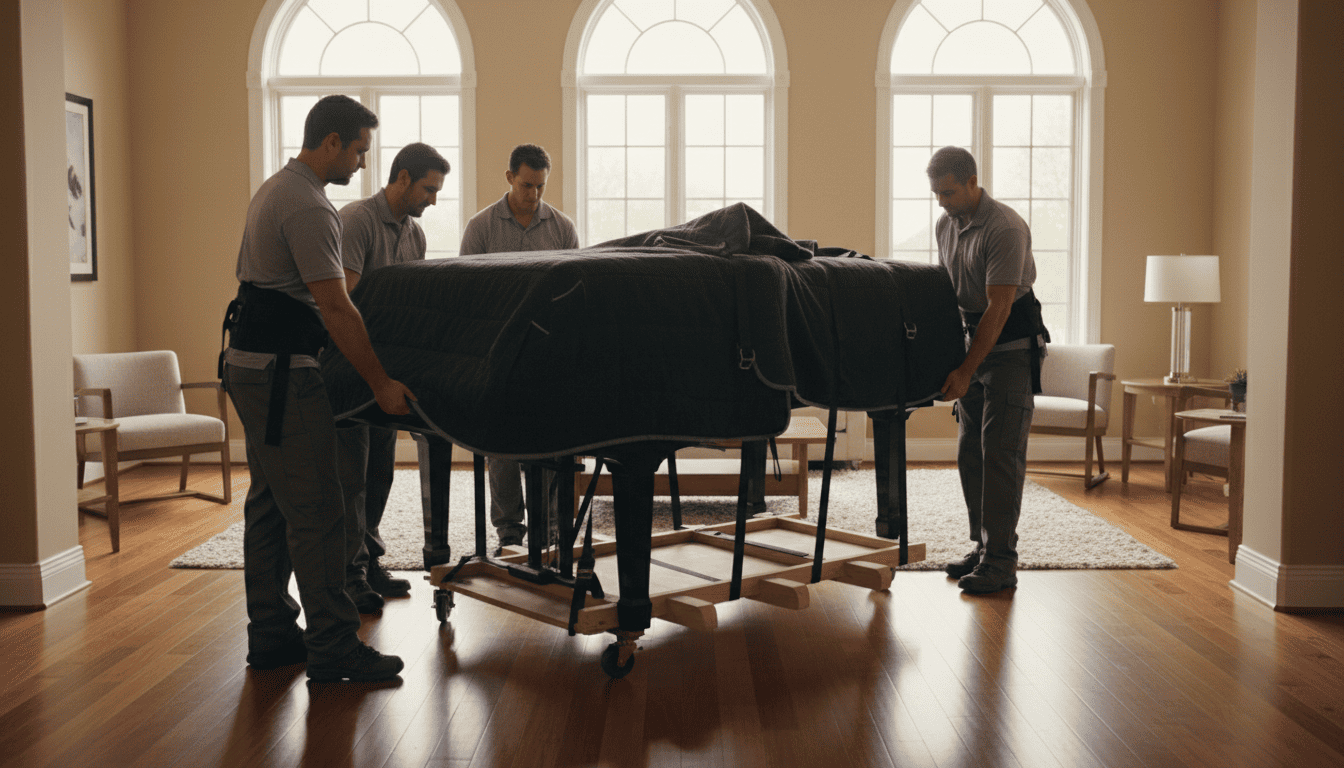
- Get it onto the dolly. With helpers steadying both sides, tilt the safe slightly to one side while someone slides the dolly plate underneath, then ease it back down. Go slowly; a tilted safe is an unstable safe.
- Strap it tight, so the safe and the dolly move as one piece.
- Find the balance point. Tilt the dolly back until the weight rests on the wheels. One person runs the handle; helpers steady the sides and stay out of the fall path.
- Roll slowly. Call out thresholds and turns before you reach them, and bridge changes in floor height with plywood.
- Take stairs one step at a time. With a powered stair climber, the operator guides and helpers steady the safe. Without one, Liberty's instructions have helpers lifting the dolly step by step; with a heavy safe, I wouldn't. Either way, nobody stands on the downhill side.
- If it starts to fall, let it fall. Liberty's advice is to jump out of the way. A gouged floor can be fixed.
Done right, nobody carries the safe's weight; you only take the tilt and the push. Keep your back straight, bend at the knees, and turn with your feet instead of twisting.
How to Transport a Gun Safe in a Truck or Trailer
Check what the vehicle can carry first. Under 49 CFR 571.110, vehicles with a gross vehicle weight rating of 10,000 pounds or less (motorcycles aside) carry a tire and loading placard, usually on the driver's side door pillar. It states the maximum combined weight of occupants and cargo, and the safe, the dolly, and every passenger count.
Pickups need extra care. Liberty notes that replacing a pickup tailgate can cost $1,500 or more, says to confirm the load rating of any ramp, and calls a rated trailer usually the better idea.
- A liftgate beats a ramp. On a ramp, go slowly, work the dolly from the uphill side, and keep everyone else beside it, never below it.
- Upright, against the front wall. Laying the safe down just means another risky lift at the other end.
- Strap it in more than one direction to the vehicle's tie-down points. Liberty warns against counting on the safe's weight to keep it from tipping.
- Pad it against the walls and the rest of the load.
- Drive gently: slow starts, early braking, wide turns. Unload in reverse, and keep the straps on until the dolly is under control.
Level It and Anchor It at the New Place
Roll the safe to its final spot before you unstrap it, and make sure the door can swing fully open there. Shim it level if the floor isn't flat; for a safe on carpet, Liberty calls leveling the most important thing.
Then bolt it down. Liberty's placement guide is blunt about why: an unanchored safe is easier to tip onto its back and pry open or to haul away, it can tip onto someone when it's opened, and it can topple in an earthquake. In Southern California, that last reason is enough on its own.
- Wood subfloor under hardwood, carpet, vinyl, or laminate: an anchoring kit made for wood floors, through the pre-drilled holes in the floor of the safe.
- Concrete: concrete anchors and a hammer drill, but rule out post-tension first. Those slabs hold steel cables under thousands of pounds of pressure that can snap out of the concrete if one is damaged. The slab should be stamped with a warning; if you're unsure, Liberty says to ask the contractor who built the house.
- Tile or stone: most installation experts don't recommend anchoring through it, and on tile it's nearly impossible without cracking it. Ask about anchoring to the wall instead.
- Renting, or can't drill the floor? Liberty's fallback is anchoring to wall studs, never just drywall. Check your lease first.
- Garage slabs give off moisture, so Liberty suggests sealing the concrete with epoxy or setting the safe on a rubber mat (safes and concrete floors).
Moving It Yourself vs. Hiring Pros
So can you do it? If you're working out how to move a gun safe by yourself, read "by yourself" as "without movers," never "alone." Knowing how to move a safe and having the people and gear to do it safely are two different things.
Even the manufacturer leans one way. Liberty Safe tells owners not to move a heavy safe on their own and notes that after renting the right equipment, you might pay close to a professional's rate anyway. For the wider tradeoffs, see our DIY moving vs. hiring movers analysis.
I'd call a crew if any of these is true:
- The safe outweighs your dolly's rating, or you can't find out what it weighs.
- There are stairs on the route and no powered stair climber.
- You have fewer than three strong helpers.
- The vehicle's payload, tailgate, or ramp rating is a guess.
- You've measured a doorway or a turn and still aren't sure the safe fits.
- The safe weighs well over a thousand pounds, or it went in by crane or through a window. That's rigging work, not a dolly job.
If that's you, our white glove moving team handles gun safes and other heavy, high-value items across Los Angeles and Orange County, starting with an evaluation of the item. Rates are on our pricing page. Whoever you hire, ask how they handle stairs and protect floors, how their liability coverage works for a single heavy item, whether they'll level and anchor the safe, and what their license number is. Ours is CAL-T201327, issued by the California Bureau of Household Goods and Services.
Frequently Asked Questions
Can one person move a gun safe?
Not safely, even across a room. Liberty Safe says never to move a safe alone because it can tip over, and it recommends at least three strong helpers. A dolly doesn't change that; someone still has to steady every tilt and turn.
What's the best way to move a gun safe across the same floor?
A heavy-duty dolly rated above the safe's weight, strapped tight, rolling over plywood if the floor scratches easily. Skip golf balls, and keep PVC rollers to smooth, hard floors.
Will movers take the guns inside the safe?
Don't plan on it. Empty the safe, carry the guns yourself, and ask the mover about its firearm policy when you book. In California, the handgun transport exemption in Penal Code 25610 requires the gun to be unloaded and locked in the trunk or in a locked container.
Can a gun safe go on a second floor?
Yes, if the stairs can hold the safe plus the people moving it and the floor can hold the safe for good. If you're unsure about the floor, Liberty recommends having a building contractor evaluate it first.
Should you bolt down a gun safe after moving it?
Yes. Liberty recommends anchoring every safe so it can't be tipped over and pried open, and it lists earthquakes among the reasons. Rule out a post-tension slab before drilling concrete; if you rent or can't drill the floor, anchor to wall studs instead.