Declutter Before Moving: A 6-Week Plan for LA and Orange County

- What Decluttering Before Moving Actually Saves You
- Keep, Sell, Donate, or Toss: How to Decide Fast
- A 6-Week Declutter Timeline
- Sentimental Items: Slow Down, but Don't Stall
- Moving and Decluttering With Kids and Partners
- Selling Furniture and Other Items Before You Move
- Where to Donate in Los Angeles and Orange County
- Bulky Items, Mattresses, E-Waste, and Hazardous Waste
- When to Bring in Professional Help
- Frequently Asked Questions
Every box you pack is a box someone has to carry, load, drive across town, and unpack again. That's the plain case for taking time to declutter before moving: fewer things on the truck, fewer boxes to buy, and a new place that doesn't start out full. Knowing you should is easy. Finding the hours, and figuring out who will actually take a 12-year-old sectional, is where most people stall.
Decluttering for a move isn't a spring clean. There's a hard deadline, a moving quote tied to how much you own, and, in Los Angeles and Orange County, rules about what can sit on the curb and what can't go in the trash at all. Here's a six-week plan, the questions I'd use to decide fast, and where everything can go once you have.
What Decluttering Before Moving Actually Saves You
Movers get paid for the effort your belongings take. NerdWallet's moving cost guide counts moving more stuff, by weight, volume, or number of rooms, among the things that raise a bill: local movers often charge by the hour, while full-service long-distance movers tend to quote a flat fee that factors in shipment weight. Either way, the dresser you leave behind is time or weight you don't pay for.
For interstate moves the link is even more direct. With a non-binding estimate, final charges are based on the actual weight of your shipment, according to the Federal Motor Carrier Safety Administration.
Then there are the smaller wins: fewer boxes and less tape to buy, fewer cartons to open at the new place, and a quote that describes the move you're actually making if you cut before the estimate. One caveat, though. Decluttering costs time too, and spending a Saturday haggling over a lamp worth less than lunch isn't saving anything.
Keep, Sell, Donate, or Toss: How to Decide Fast
Set up four piles: keep, sell, donate, and toss or recycle. Add one small box, kept apart from the rest, for anything hazardous, like old paint, pool chemicals, or a propane cylinder, because those follow different rules. Then ask a few questions.
- Have I used it in the past year? A full year covers holiday decorations and camping gear. The stricter 90/90 rule from The Minimalists asks whether you've used something in the last 90 days and will use it in the next 90.
- Would I buy it again today? If not, you're keeping it out of habit.
- Will it fit the new place? Measure the rooms or ask for a floor plan. A quick video of the new closets settles a lot of furniture debates.
- Is it cheap and quick to replace? The Minimalists' 20/20 rule holds that almost anything you keep "just in case" can be replaced for less than $20 in less than 20 minutes.
- Could someone else use it? Charities want clean, working, sellable things. Broken or stained items belong in the toss-or-recycle pile.
- Do I own two? Keep the one you reach for first.
The test I'd throw out is "I might need it someday." Everything passes it, which is exactly why it's useless.
A 6-Week Declutter Timeline
Most declutter before moving tips boil down to "start early," and early only helps if it's on a calendar. If you're working out how to declutter your home before moving without losing every weekend, go from the spaces you use least to the rooms you live in. Keep sessions short: two or three a week, a timer set for 30 to 60 minutes, and one closet finished instead of a whole room half-sorted.
Six weeks out: list the big stuff
Walk through with your phone and note every large item: furniture, appliances, the treadmill, the spare mattress. Big pieces take the longest to sell or give away, so decide on them first. Check them against the new place's measurements, and list anything that won't fit for sale this week.
Five weeks out: garage, storage, and hidden corners
Start where you won't miss anything: the garage, the hall closet, under the beds, the cabinet above the fridge, a storage unit. Boxes still taped shut from your last move are a strong hint. Pull old paint, solvents, and car fluids into the hazardous box now. They can't go in the regular trash, and a drop-off trip is easier to plan this week than during moving week.
Four weeks out: closets and bedrooms
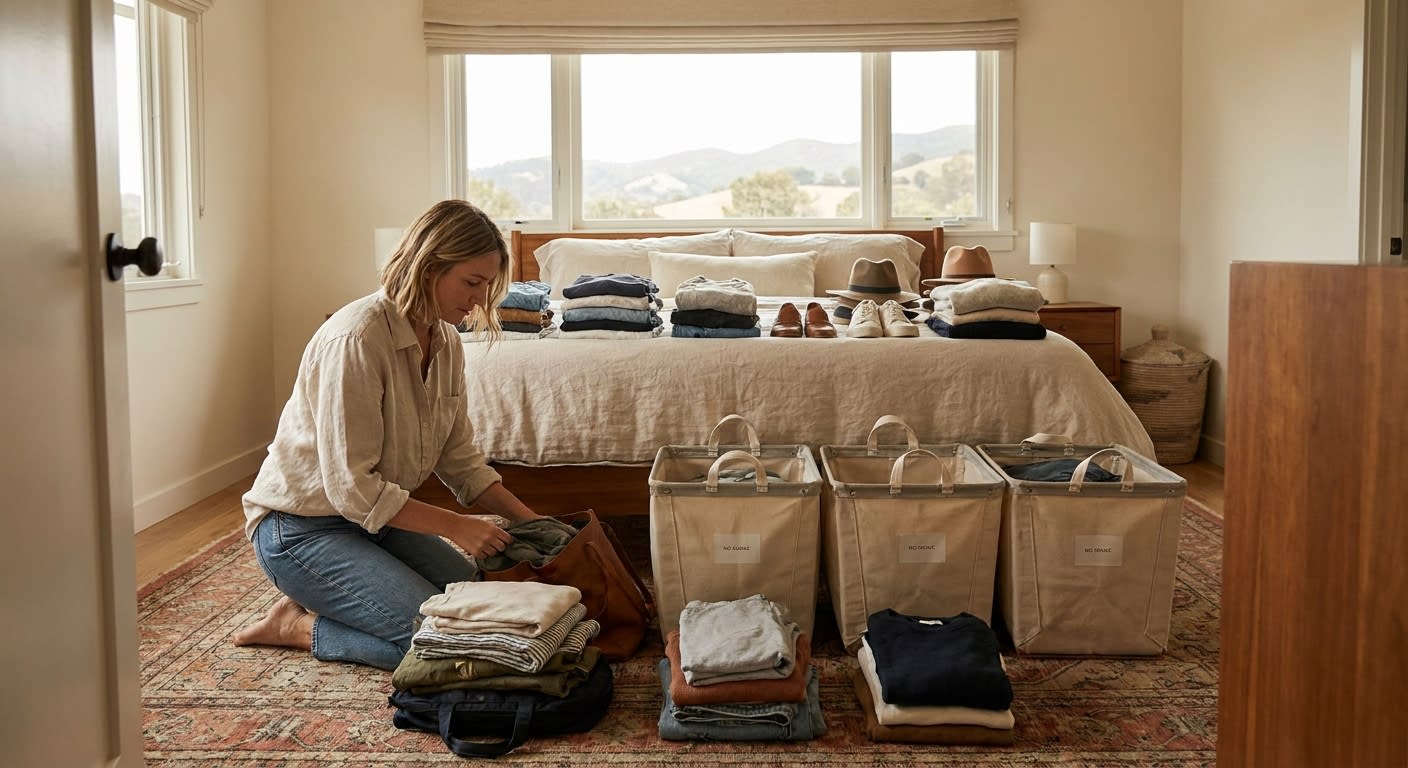
Clothes go quickly with the one-year question. Try on the "someday" pieces and bag whatever doesn't fit or wouldn't get worn this month. Count sheets and towels against the beds and bathrooms you'll actually have. Let kids sort their own rooms with you nearby, and book donation pickups for the bags that are piling up.
Three weeks out: kitchen, living room, and paperwork
Kitchens hide duplicates: two can openers, a tower of mismatched containers, the bread maker from one ambitious winter. Books are heavy, so be choosy. Shred old statements you no longer need, scan papers you keep only for reference, and put passports, birth certificates, titles, and tax records in one folder that rides with you, not on the truck. Back up and wipe any old phone or laptop before it goes to recycling.
Two weeks out: furniture, pickups, and drop-offs
Make the final calls on big items. Anything unsold goes to a donation or bulky item pickup, and the hazardous box and dead electronics go to a drop-off site (details below). If your building has an elevator, reserve it for pickup day just as you would for the move.
Moving week: pantry, bathroom, and the last sweep
Cook from what's already in the fridge and pantry, and finish half-empty toiletries and cleaning sprays instead of packing them. Do one last lap with a bag in hand: junk drawers, the medicine cabinet, the shelf by the door. Whatever's left in the "maybe" pile gets a decision now.
For the rest of the move calendar, from booking movers to changing your address, see our 8-week moving checklist for Los Angeles.
Sentimental Items: Slow Down, but Don't Stall
Don't open with the letters, the photo albums, and your grandmother's china. Sentimental items are slow by nature, and getting stuck on them early drains the momentum you need for the garage. Save them for the second half of the plan, then try this:
- Choose the container first. One memory box per person forces you to keep the best pieces instead of everything.
- Photograph what you want to remember but don't need to store. Trophies, school art, a drawer of concert T-shirts.
- Ask family before giving away heirlooms. A cousin may want the piece you feel guilty about.
- Allow a few maybes. If you truly can't decide, pack it, date the box, and decide at the new place. Just don't let "a few" become the whole closet.
Moving and Decluttering With Kids and Partners
Moving and decluttering at the same time asks a lot of kids, who are already giving up a familiar room. Give them real choices inside clear limits: one bin of stuffed animals, one shelf of books. Younger kids can pick which toys go to another family, and teens can handle their own closets. I'd take a slow family sort over a quick purge while the kids are at school, if only to skip the "where's my..." conversation a month later.
The same goes for partners and roommates: nobody decides about someone else's things without asking. Start with shared spaces like the kitchen and the garage. For the emotional side of the move, see our guide to moving with kids in Los Angeles.
Selling Furniture and Other Items Before You Move
Selling pays off for things with real resale value: solid wood furniture, newer appliances, bikes, designer clothes, electronics in good shape. For most other things, the hours spent answering "is this still available?" add up fast.
- Where: Facebook Marketplace, OfferUp, Craigslist, and Nextdoor for furniture and household goods; eBay or Poshmark for clothing and collectibles.
- When: list big pieces six weeks out, so there's room to reschedule buyers who don't show.
- Price: price to sell and set a "donate by" date. Still unsold two weeks before the move? It goes to a donation pickup.
- Pickup: ask buyers to bring their own help and vehicle, and check your building's rules for moving furniture through the lobby and elevator.
Where to Donate in Los Angeles and Orange County
Every organization has its own accepted-items list, and drivers can turn things down at the door. Read the list before you book, and don't leave donations for moving week, so there's time for a plan B.
| Organization | Good for | Pickup | Won't take |
|---|---|---|---|
| Habitat for Humanity of Greater Los Angeles ReStores (Bellflower, Torrance, Los Angeles) | Furniture with no broken or missing pieces, appliances less than 8 years old, building materials, boxed home goods | Drop-off is free; scheduled pickups carry a fee | Mattresses and box springs, clothes and shoes, children's items, paint |
| Out of the Closet (AIDS Healthcare Foundation) | Adult clothing, select furniture, kitchenware, electronics, books and records | Free with at least two large furniture items or ten large bags or boxes; bookings open one week ahead | Mattresses and bed frames, linens and towels, children's clothing and gear, TVs and appliances over 3 years old |
| The Salvation Army | Unbroken furniture, working appliances that aren't built in, clothing, household goods, bikes, books | Free pickup, requested online or by phone | Built-in or gas appliances, TVs older than 5 years, auto parts, paint and chemicals; rules vary by location |
| Goodwill Southern California | Clothing, small appliances, furnishings, books, computers in good or new condition | No pickup; drop off at a store or donation center, where attendants give receipts | See its donation guidelines; Orange County Goodwill stores are run separately |
| Habitat for Humanity of Orange County ReStores (Santa Ana, Anaheim) | Furniture, appliances, flooring, building materials | Standard and priority pickup options | Check before booking |
Keep every receipt. According to IRS Publication 526, you generally need to itemize to deduct donations, and clothing and household items count only in good used condition or better. A single contribution of $250 or more needs a written acknowledgment from the charity, and noncash donations totaling more than $500 for the year mean filing Form 8283.
Bulky Items, Mattresses, E-Waste, and Hazardous Waste
Some things can't be donated and shouldn't go in your bin either.
Bulky item pickup in the City of Los Angeles
If the City of Los Angeles collects your trash, LA Sanitation picks up couches, mattresses, and other large household items for free. Request it through MyLA311 at least one day before your regular collection day, with an itemized list ready; pickup happens on your trash day, and online requests take two days to process. TVs, computers, and microwaves need a separate electronic waste request, washers and refrigerators a metal and household appliance request, and construction materials, auto parts, and cardboard aren't collected (MyLA311).
Book before anything goes outside. Leaving an old sofa, mattress, or refrigerator on the curb is against the law in the City of Los Angeles, and the City asks residents to call 311 first (LA City Council District 2). Outside city limits, check your own city's trash service; some cities offer free bulky pickup, and the Bye Bye Mattress site below has a lookup for it.
Mattresses
Buying a new mattress for the new place? California law requires the retailer to offer to take back your old one at no additional cost when it delivers, though delivery fees may still apply. Participating collection sites also accept old mattresses for recycling at no charge (Bye Bye Mattress).
Paint, chemicals, batteries, and electronics
- Los Angeles County: any county resident can drop off household hazardous waste and e-waste free at the City of LA's seven S.A.F.E. Centers, from Sun Valley and Northridge to San Pedro and UCLA; most are open Saturdays and Sundays, 9 a.m. to 3 p.m. The county also runs free drive-through collection events, mostly on Saturdays, with no appointment needed. The limit is 15 gallons or 125 pounds per trip, and the events don't take tires, ammunition, or appliances like refrigerators (LA County Public Works).
- Orange County: four county centers in Anaheim, Huntington Beach, Irvine, and San Juan Capistrano take household hazardous waste and e-waste free from OC residents, Tuesday through Saturday, 9 a.m. to 3 p.m. Wipe devices first, since the county doesn't destroy hard drives or phones on site (OC Waste & Recycling).
- Leftover paint: PaintCare drop-off sites around California take house paint, primers, stains, sealers, and varnish at no charge (PaintCare).
- Old medications: don't flush them. LA County lists medicine take-back sites and free mail-back envelopes (CleanLA).
What shouldn't ride with your furniture
There's a moving reason to clear these out early, too. Federal law forbids shipping hazardous materials in household goods boxes without telling your mover, and the FMCSA's examples read like a garage shelf: paint thinners, lighter fluid, gasoline, propane cylinders, car chemicals. Packing them without the mover's knowledge can also limit the mover's liability (FMCSA). Use them up, give them to a neighbor, or add them to the drop-off trip.
If you live in an apartment or condo
- Ask management whether donation and buyer pickups need an elevator or loading dock reservation.
- If the building requires a certificate of insurance from anyone hauling items out, request one when you book. Out of the Closet, for one, handles COI requests through its dispatch office.
- Stage items where crews can reach them. Out of the Closet's drivers carry items up or down only one flight of stairs when there's no elevator, and Habitat LA asks donors to have items on the ground level.
- Warn drivers and buyers about loading zones and permit-only parking on your street.
When to Bring in Professional Help
Decluttering is the part only you can do, because only you know what matters. Green Moving doesn't haul away junk or unwanted furniture, so selling, donating, and drop-offs need to be finished before moving day. And if the decisions themselves are the sticking point, a professional organizer is a better fit than a moving crew.
Movers help with what's staying. If you've pared down but packing still feels like a second job, our packing and unpacking service can pack the whole house or just the fragile pieces, then unpack at the new place. To hand off the entire project, full-service moving puts packing, loading, transport, and unpacking under one coordinator. Rates for both are on our pricing page.
Frequently Asked Questions
How do I declutter before moving with only two weeks?
Skip the detailed pass and go after volume. Decide on furniture and other large items first, book donation or bulky pickups right away, and do the hazardous waste drop-off that weekend. Then make timed passes through closets and the kitchen, and pack anything undecided to sort after the move.
Should I start packing before I finish decluttering?
Yes, zone by zone. Once a closet or shelf is sorted, box and label the keepers right away, so you don't handle the same things twice. The growing stack of finished boxes is also proof you're getting somewhere. Leave the rooms you use every day for last.
What if I want to get rid of nearly everything and start over?
Work from value down. List what's worth selling and give each listing a deadline, book one or two large donation pickups, and send whatever charities won't take to a bulky item pickup or drop-off site. Keep documents, medications, and anything irreplaceable with you.
Should I declutter before getting a moving estimate?
Make at least the big decisions first. An estimate reflects what the mover sees or what you list, so furniture you're selling or donating shouldn't be part of it. If you can't finish before the walkthrough, point out which pieces are going.
How do I get rid of things nobody will take?
Separate anything hazardous or electronic first: in LA County it goes to a S.A.F.E. Center or a county collection event, and in Orange County to one of the four county centers. Large items go to a bulky item pickup, old mattresses to a Bye Bye Mattress collection site, and the rest to your regular trash and recycling.